
Online event
Our CSR Webinars
×
Check out our webinars, replays, and upcoming sessions to start taking action on your CSR strategy.
Sign up for the next sessionCheck out our webinars, replays, and upcoming sessions to start taking action on your CSR strategy.
Sign up for the next sessionManufacturer, importer, distributor, or EPR producer? Discover how to identify your role under the European PPWR packaging regulation, your obligations, and the steps to take, with a practical case study.


This article breaks down, role by role, who does what, complete with examples and a practical case study. For an overview of the regulation, its timeline, and its sustainability requirements, start by checking out our complete PPWR guide.
When faced with the PPWR, many companies start by asking whether their packaging is recyclable or contains prohibited substances. That’s a good question, but it’s not the first one. Before evaluating packaging, you need to know which obligations apply to you, and those depend entirely on the role you play.
A simple example: if you resell a product in its original packaging without changing anything, you don't have to assess the packaging's compliance in place of its manufacturer, but you must verify that it is compliant before distributing it. Conversely, if you have your own boxes made under your own name, it is up to you to prove their compliance. Two situations, two very different workloads.
What makes things tricky is that a business rarely plays just one role. It might handle several types of packaging (retail boxes, shipping cartons, void fill, labels) and act as a distributor for some, a manufacturer for others, and an importer for yet others. The right approach is to assess each packaging item separately.
The regulation refers to these roles as economic operators. Here are their definitions, in the order they appear in the supply chain.
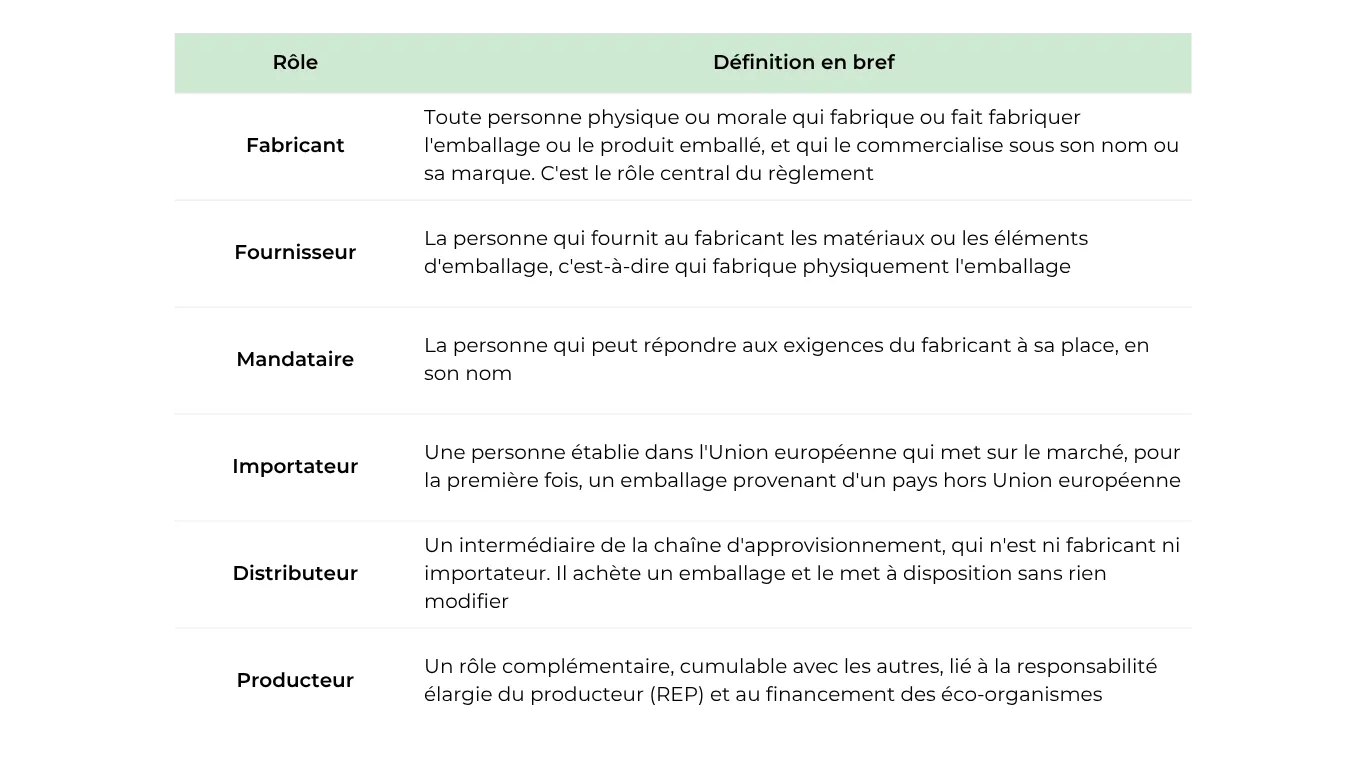
The three most confusing points:
- The supplier physically produces the packaging components, like the cardboard or plastic film. Under the regulation, they sit upstream of the manufacturer.
- The authorized representative isn't a role forced on you—it's someone the manufacturer appoints to act on their behalf. They help handle obligations, such as carrying out the conformity assessment.
- The producer is a separate role. You can be both a producer and a manufacturer, a producer and a distributor, or a producer and an importer. This is the role that triggers EPR obligations.
This is the most important question in the regulation because the manufacturer holds the bulk of the obligations. Contrary to what the word might suggest, the manufacturer is not necessarily the one who physically makes the cardboard box or plastic packaging. It is the entity that packages the product and puts its brand name on it.
First criterion: branding. The question you need to ask is simple: does the packaged product carry my brand? If so, you're almost certainly the manufacturer of that packaging. A company that has boxes made by a subcontractor and sells them under its own name is the manufacturer, even without owning a single piece of production equipment. The subcontractor is simply the supplier.
Importers and distributors can become manufacturers. If they modify packaging after receiving it and put their own brand on it, their role changes and they take on the manufacturer's responsibilities. That's why maintaining the compliance of packaging you don't manufacture yourself is critical.
Second criterion: unbranded packaging. You then have to choose between two candidates: the supplier who physically makes the packaging, or the person placing the packaged products on the market. To figure it out, look at who places the order and who calls the shots on packaging design. In other words, who ultimately makes the decisions about that packaging.
An exemption for micro-enterprises. The regulation sets out special rules for micro-enterprises—businesses with fewer than 10 employees and an annual turnover under €2 million. This notably applies when a micro-enterprise supplies the packaging and is based in the same Member State as the manufacturer. If this sounds like you, check the legal text closely to see how liability is divided up.
The concept of the producer is the most technical because it depends on the country. It is directly linked to EPR: the producer must fund packaging waste management. Here are three situations to help you understand it.
Case 1: you are based in France and make packaging available in France for the first time. You count as a producer under the PPWR. This triggers obligations under the EPR framework, including paying fees to producer responsibility organizations.
Case 2: you sell directly to end users in another Member State. Whether you're based in France or outside the EU, if you sell directly to German consumers—say, through your website—you are also considered a producer in that Member State.
Case 3: you go through an intermediary. A French wholesaler sells a packaged product to a store in Germany, and that store sells it to its customers. Here, the German store is the producer, not the wholesaler.
The difference is as follows: you are a producer in another Member State if you sell directly to end-users in that state. If you go through an intermediary who resells the product themselves, the intermediary becomes the producer.
Let's take a French company that makes biscuits, packs them in cardboard boxes, and sells them under its own brand in France. Here are the roles surrounding this packaging.
A single company holds three roles here (importer, manufacturer, producer) for a single box. It is precisely this overlap that makes the exercise difficult when you try to figure it out off the top of your head.
Once the roles have been identified, here is what the regulation expects from each one.
The manufacturer is at the heart of the PPWR. They must:
The supplier must provide the manufacturer with all the information and documentation needed to carry out their own conformity assessment. For example, they must specify the composition of the materials, whether they contain recycled content, and if any substances of concern are used. Without this information, the manufacturer cannot issue their declaration.
The importer brings pre-made packaging into the Union that is assumed to be compliant. They must:
In practical terms, they must request the declaration of conformity from the manufacturer and ensure that the technical documentation has been prepared and will be available to the authorities. The importer does not have to produce these documents themselves, but they do have a duty of care.
The distributor acts as a watchdog. They must:
The producer funds packaging waste management by contributing to an eco-organization. There are several eco-organizations depending on the sector. They must:
The authorized representative acts on behalf of the manufacturer. They can carry out the conformity assessment in their place and help them meet their obligations.
These two documents are the primary proof of compliance. They are the responsibility of the manufacturer.
The EU declaration of conformity must be drawn up for each type of packaging placed on the market. It's a fairly standard, straightforward document that notably includes:
It must be kept available for national authorities.
Technical documentation goes much deeper. It details how the packaging is made, any standards it meets, its material composition, recyclability, and recycled content. The manufacturer has to get this info from their supplier. The required details are listed in an annex to the regulation, which manufacturers must follow step by step.
The logic is simple: technical documentation contains the evidence, and the EU Declaration of Conformity is the signed summary. You can't have one without the other.
All operators are subject to traceability requirements, even those who aren't manufacturers. You must keep records of all your suppliers and customers so you can track the origin and journey of any packaging that has passed through your hands. The goal is to be able to prove, in the event of an audit, that all the packaging you handled was compliant.
Our experts recommend retention periods of approximately five years for single-use packaging and ten years for reusable packaging. These timeframes apply to both the declaration of conformity and your supplier and customer records.
This requires a practical organizational system: a packaging database, suppliers linked to each reference, dated and archived documents, and a way to retrieve them quickly. That’s why many companies choose to use a dedicated tool rather than managing it all in spreadsheets.
To show how these roles work together, we created a case study during our webinar featuring a fictional company we'll call Ordi Reventes.
Ordi Reventes is based in France and operates as follows:
We list the main packaging items:
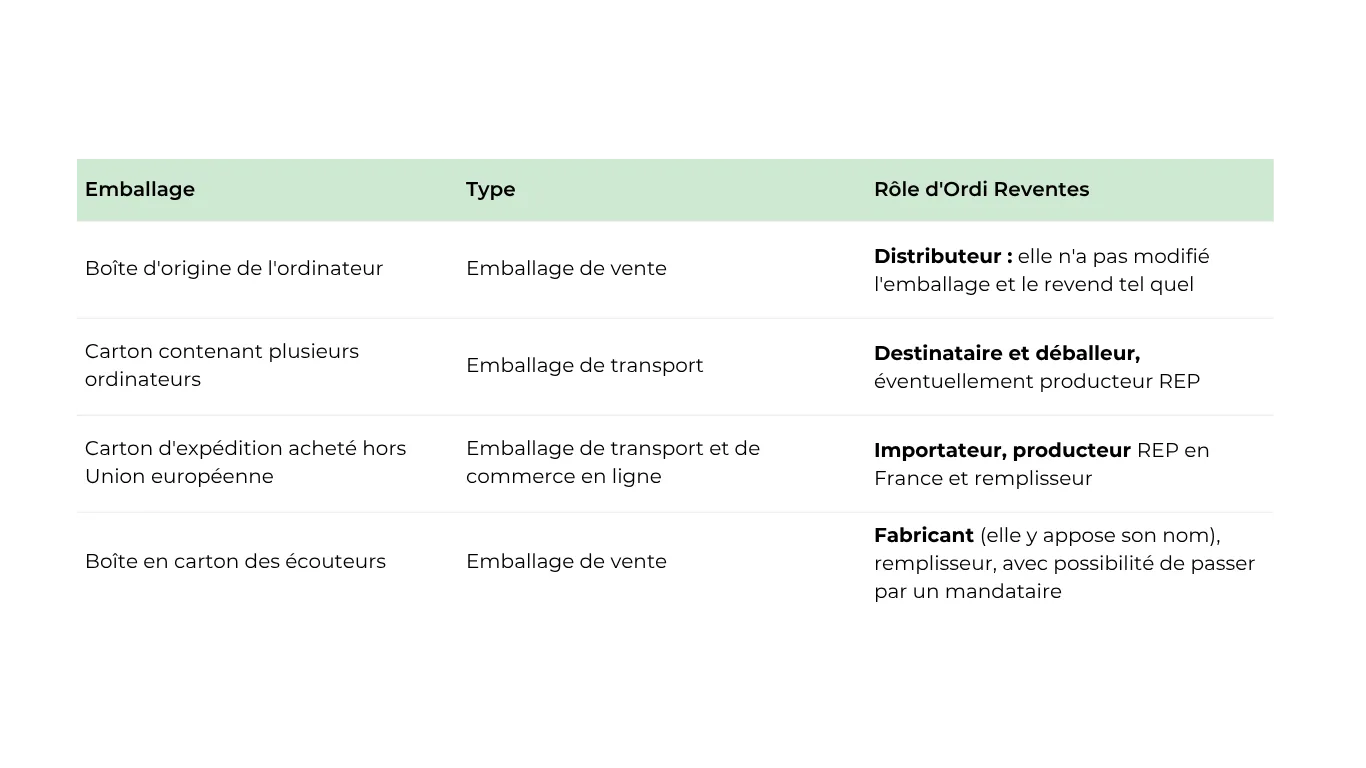
The computer's original box (distributor). Ordi Reventes can't distribute non-compliant packaging, so it checks for compliance. It also has to maintain that compliance throughout storage and transport. Heads up: if it fails to do so, it can be treated as the manufacturer, meaning it would have to handle conformity assessments, the declaration, and technical documentation. Preserving the compliance of received packaging is a big deal.
The master carton holding several computers (recipient and unpacker). Unpacking packaging comes with responsibilities. Ordi Reventes receives this carton from France, so it was likely already placed on the market by another operator, meaning Ordi Reventes isn't the first to make it available. Normally, they wouldn't be considered the producer of this carton. But if they unpack the products, aren't the end user because they resell them, and no other EPR producer is identified, they could be classified as the EPR producer. That means registering for EPR and paying eco-fees.
The shipping carton purchased outside the European Union (multiple roles).
The cardboard box for the headphones (manufacturer). Ordi Reventes puts its brand on it, making them the manufacturer. They must carry out—or have an authorized representative carry out—a conformity assessment covering substances of concern, recyclability, weight, and volume. If the box doesn't comply, they need to redesign it before creating the technical documentation and declaration of conformity. Since they also fill the box, they have to minimize empty space, following the regulation's minimization rules for sales packaging.
This case highlights something essential: compliance depends just as much on the flow of goods (whether they originate from within the EU or not, and who is the first to place them on the market) as it does on whether you apply your own brand or modify the packaging.
To get started, here is the method we recommend.
If your assessment reveals non-compliant packaging, here is the process to follow, especially if you are a manufacturer:
This step can quickly become a full-blown eco-design project. A life cycle assessment helps compare replacement scenarios and ensures you don't solve one problem by creating another.
Who counts as the manufacturer under the PPWR? It's anyone who manufactures—or has manufactured—packaging or a packaged product and markets it under their own name or trademark. They don't necessarily have to physically make the packaging themselves.
Is my company considered a manufacturer if I outsource box production to a subcontractor? Yes, as long as the boxes are sold under your name or brand. The subcontractor is simply your supplier.
What is a distributor under the PPWR? An intermediary who buys packaging and makes it available without modifying it. They are neither a manufacturer nor an importer. They must verify that the packaging complies with regulations and that the producer is properly registered for EPR.
Can a distributor become a manufacturer? Yes. If they modify the packaging and put their own brand on it, or if they fail to maintain its compliance, they take on the manufacturer's obligations.
What are an importer's responsibilities? They need to check that the manufacturer meets their obligations, request the declaration of conformity, ensure technical documentation exists and can be shared with authorities, and make sure storage and transport don't compromise compliance.
What is an EPR producer? It's any business that makes packaging available in a Member State for the first time, or sells directly to end users in another Member State. They fund packaging waste management through a producer responsibility organisation (PRO) and register with their sector's reporting system.
Where can I find what's required in the technical documentation? It's detailed in an annex to the regulation. You can check out the full text on EUR-Lex, and the European Commission has an FAQ that clears up several implementation details.
Do I need a declaration of conformity for each packaging item? You must draw up an EU declaration of conformity for each type of packaging placed on the market.
The regulation is complex, and every company has a unique situation regarding its packaging, suppliers, and cross-border flows. It is most helpful to analyze your specific situation before launching a project.
At Altopi, we qualify your operator roles, map your packaging portfolio, and build a compliance matrix for each packaging family. We then support you in achieving compliance and producing the necessary documentation. Our PPWR 360 application then centralizes your file and keeps it updated with every new reference, supplier, or regulatory change.
Want to figure out your roles and where to start? 👉 Check out our PPWR support services or book a call with an Altopi expert.