
Online event
Our CSR Webinars
×
Check out our webinars, replays, and upcoming sessions to start taking action on your CSR strategy.
Sign up for the next sessionCheck out our webinars, replays, and upcoming sessions to start taking action on your CSR strategy.
Sign up for the next sessionWhat is the PPWR? Obligations, 2026-2040 timeline, PFAS, recyclability, recycled content, labeling, and penalties: the complete guide to the European packaging and packaging waste regulation.


Here is the essential information to keep in mind before diving into the details.
This article provides an overview of the regulation. To find out exactly what you need to do based on your role, our article dedicated to operator roles and obligations guides you step-by-step with a practical case study.
PPWR stands for the Packaging and Packaging Waste Regulation. It's the European Union's benchmark framework covering how packaging is designed, put on the market, and managed at the end of its life. Officially referenced as Regulation (EU) 2025/40, you can read the full text on EUR-Lex.
Under the regulation, packaging is defined as any product intended to contain, protect, handle, deliver, or present other products, and which is not an integral part of those products. This covers household packaging as well as commercial and industrial packaging: a product's cardboard box, the film bundling multiple units, the shipping carton for an online order, or a shrink-wrapped pallet.
The PPWR is a long and dense text that touches on packaging composition, design, labeling, proof of conformity, and Extended Producer Responsibility (EPR). That is why it is easier to read in large blocks. At Altopi, we present it from three angles: operators (who is affected and what their role is), sustainability requirements (what the packaging must comply with), and declarations (how to prove conformity). This article follows that logic.
This is not a new topic. The current regulation replaces a framework that had already been in place for a long time.
There was a starting point, but the PPWR is much more ambitious than previous texts. Two differences change the game. First, it is a regulation rather than a directive: there is no longer any national transposition that leaves room for interpretation by each country; the same rules apply everywhere in Europe. Second, it covers the entire life cycle of packaging, from design to recycling, rather than just waste management.
To help you put it into practice, the European Commission rolled out guidelines and an FAQ in 2026, updating them regularly. You can find them on the Commission's PPWR page. While these documents aren't legally binding, they do clear up how to read the text—especially when it comes to figuring out who counts as a manufacturer versus a producer.
The regulation pursues three main objectives.
1. Cut unnecessary packaging and shrink its footprint. The goal is to tackle the packaging itself: ditch it when it's not needed, and make sure whatever's left is reusable, recyclable, and made with recycled content.
2. Standardize practices across every country. Before the PPWR, every member state could set its own rules, making life a headache for businesses selling across borders. With a single set of rules, the drive to cut packaging applies the exact same way everywhere, across every pillar of the regulation.
3. Support the European Green Deal. The PPWR plays a key role in Europe's goal to reach climate neutrality by 2050. It leans on the circular economy to keep packaging impacts in check, especially carbon footprints.
The regulation covers all packaging placed on the European Union market, regardless of material or origin. It therefore potentially concerns any company that manufactures, imports, distributes, uses, or resells packaged products.
What determines your obligations is not your business sector, but the role you play for each piece of packaging. We refer to these as economic operators. The regulation distinguishes several:
A single company can hold multiple roles and play different roles depending on the packaging in question. A company that resells a product in its original box is a distributor for that packaging, but it may be the manufacturer for the box it has produced under its own name. One point that often surprises people: the manufacturer is not necessarily the one who physically makes the packaging. All these roles, their definitions, and their obligations are detailed in our article on operator roles in the PPWR.
Once your role is identified, the next question is: does my packaging meet the regulation's requirements? There are many sustainability requirements, and they depend on the type of packaging. They are not the same for cardboard, plastic, or glass packaging. They do not all apply at the same time: they are phased in over time, from August 12, 2026, through 2040. They can be grouped into five main families.
The regulation limits the presence of substances of concern in packaging. This applies to all packaging: it must contain very low levels of heavy metals, with maximum concentrations per kilogram of packaging that must be respected.
PFAS (per- and polyfluoroalkyl substances, often dubbed "forever chemicals") face a much tighter ban when it comes to food packaging. Since August 12, 2026, food-contact packaging can no longer hit the market if it contains PFAS above the regulation's limits. One critical point: there's no transition period for these chemicals. Packaging already on the market before that date doesn't need to be pulled, but any new packaging has to stay within the limits.
For you, this means asking your suppliers about the composition of their materials: coatings, inks, adhesives, and surface treatments. Information like this doesn't come together in a day, which is why it's best to get started early.
The PPWR distinguishes between two concepts that are often confused.
Regarding recyclability, the regulation sets a phased-in approach. Starting January 1, 2030, packaging must be designed for recycling and categorized into recyclability performance classes, with Class C being the lowest accepted level. From 2035, it must be effectively recycled at scale, rather than just being theoretically recyclable. In 2038, the requirements become stricter: only Classes A and B will remain permitted on the European market.
In practice, the packaging you put on the market must be largely recyclable. Composite packaging, which combines multiple materials that are difficult to separate, is the first to be affected. The precise methods for assessing recyclability depend on implementing acts that the Commission has yet to publish, which is why it is important to keep track of updates to the text.
For plastic packaging, the regulation mandates a minimum share of recycled material. Starting in 2030, the required rates will range from 10% to 35% depending on the type of packaging, and will then increase in 2040, reaching up to 65% for certain categories. These rates vary depending on whether the packaging is in contact with food and the type of polymer used.
The challenge for manufacturers is twofold: finding high-quality recycled material in sufficient quantities and proving its origin. The rates are high enough that suppliers and recyclers will need to organize, which could tighten supply.
The principle is simple: packaging must be as small and light as possible, given its function. In concrete terms, the regulation aims to limit:
On this last point, starting January 1, 2030, grouping, transport, and e-commerce packaging must not contain more than 50% empty space. A shipping box half-filled with padding will no longer be accepted. The regulation also restricts certain single-use packaging formats starting in 2030 when they are considered unnecessary.
This is arguably the most technically demanding point. As part of a circular economy approach, the regulation seeks to develop reusable packaging that can be used multiple times while maintaining its technical characteristics, particularly hygiene. This requires setting up take-back systems and reuse circuits, especially for beverages.
Takeaway sales are directly affected: merchants must allow customers to bring their own containers and, eventually, offer a reusable option. The regulation also plans for a deposit system for plastic bottles and cans by 2029, with a 90% separate collection target.
The PPWR does more than just regulate the packaging itself. It also harmonizes its labeling so that it is the same throughout the European Union.
As we interpret the text, information identifying the manufacturer and the packaging composition must be provided as soon as the regulation takes effect. Additional labels will follow:
The goal is a single labeling system that provides everyone with the same information about packaging composition, recycled content, and how to reuse or sort it.
France already has well-established sorting labels, like Triman and Info-tri. We don't yet know exactly how they'll work alongside the upcoming European label. It's definitely something to keep an eye on, especially through producer responsibility organizations like Citeo.
The regulation will be implemented in stages over about fifteen years. Here are the key milestones to keep in mind.
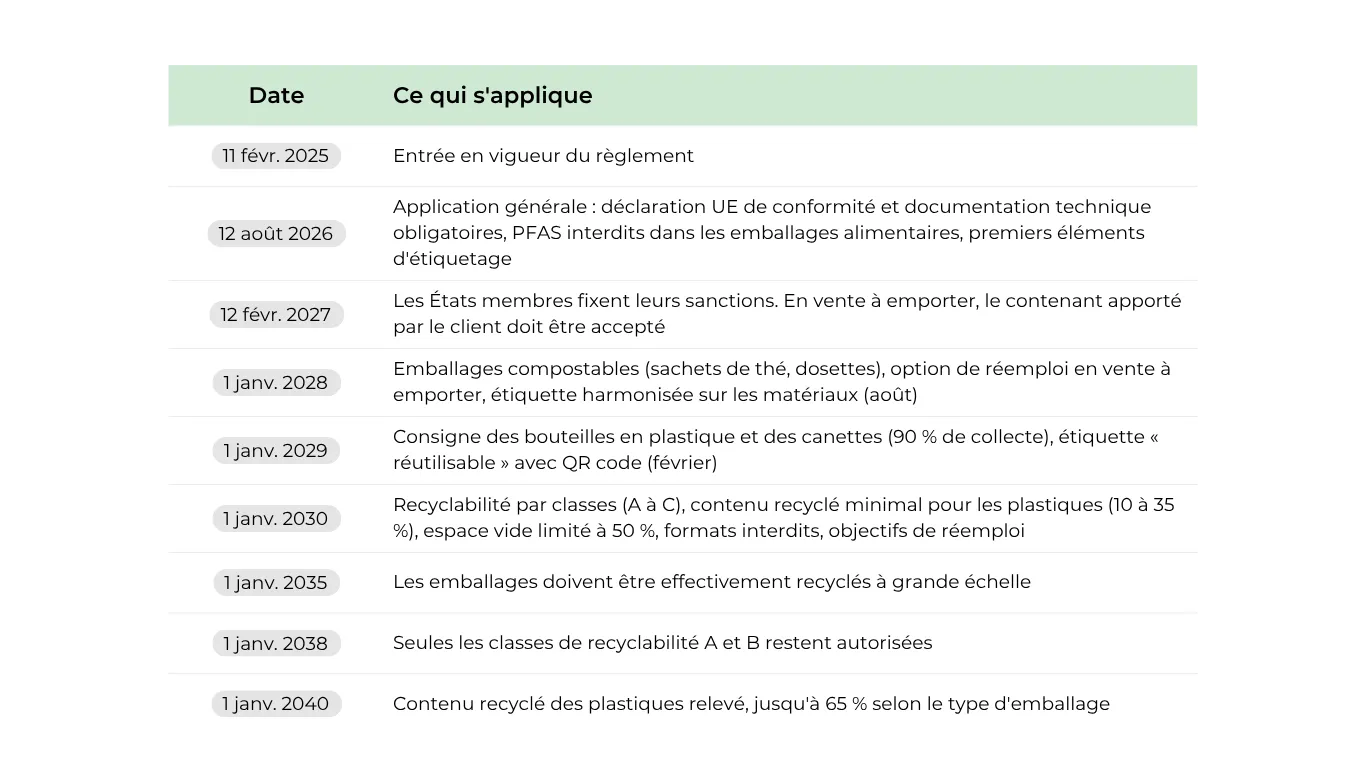
A few useful clarifications. Some dates still depend on the publication of implementing and delegated acts by the Commission and may therefore change. The most significant design obligations arrive in 2030, but the groundwork—such as gathering supplier data, testing, and switching materials—often takes several years. This is what makes the timeline deceptive: 2030 feels far off, but packaging redesigns need to start now.
The regulation lets each member state establish its own penalties for manufacturers or other operators who don't follow the rules. These penalties have to be set by February 12, 2027 at the latest. That means France needs to put forward its framework in early 2027.
The specific types of penalties are not yet known. We can expect administrative fines, as well as measures to withdraw non-compliant packaging from the market or recall it. In other words, the risk isn't just financial: non-compliant packaging could block the sale of an entire product.
The PPWR adds to an already busy regulatory landscape, which in France includes the AGEC law (anti-waste for a circular economy) and Extended Producer Responsibility (EPR) schemes.
This coordination is a point to watch: national rules will evolve to align with the European regulation. You need to track both levels in parallel.
Meeting the requirements isn't enough; you must be able to demonstrate it during an inspection. The regulation provides for three elements to do this.
The EU Declaration of Conformity – Drawn up by the manufacturer for every packaging type brought to market. It's a pretty standard document that identifies the manufacturer, gives the packaging a unique ID, details it thoroughly so it can be tracked down, and certifies that it meets all applicable requirements.
The technical documentation – More detailed, this lays out how the packaging is made, which standards it complies with, its composition, recyclability, and recycled content. Manufacturers need to get this info from their suppliers. Exactly what's required is laid out in an annex to the regulation.
Traceability – Every operator, even non-manufacturers, must keep records of their suppliers and customers to track where any packaging passing through their hands came from. Our experts point to retention periods of five years for single-use packaging and ten years for reusable packaging.
The detailed content of these documents, broken down by role, is described in our article on operator obligations.
Faced with such a dense text, the best approach is to move forward in stages.
We detail each of these steps in our article on roles and obligations, which includes a company example.
Is the PPWR already in force? Yes. The regulation officially took effect on February 11, 2025, and generally kicked in on August 12, 2026. A few specific requirements will roll out later, stretching up to 2040.
Is the PPWR a directive or a regulation? It's an EU regulation. That means it applies directly across all member states without needing to be written into national law first.
Does this affect my business? If you manufacture, import, distribute, or sell packaged goods, or if you place packaging on the EU market, yes. Your specific obligations will come down to your role for each type of packaging.
What does the PPWR change for PFAS? Since August 12, 2026, food packaging containing PFAS above the set limits cannot be placed on the market, with zero grace period for new packaging.
When do packages have to be recyclable? Starting January 1, 2030, for design-for-recycling requirements, with standards tightening over time: large-scale recycling by 2035, and only performance grades A and B allowed by 2038.
What penalties are on the table? Each member state sets its own, and they must be finalized by February 12, 2027. They could include fines, market withdrawals, or recalls of non-compliant packaging.
Does the PPWR replace France's AGEC law? No, but if there's ever a conflict, EU law takes precedence. EPR schemes stay in place, and an adaptation bill is currently under discussion to bring French law into full alignment.
How long does it take to get compliant? It really depends on how many packages you handle and how complex your supply chain is. Assessing your portfolio and collecting data often takes weeks or months, and redesigning packaging can easily take several years.
The PPWR is complex, and you need to analyze your specific situation: your packaging types, your role, your suppliers, and your timeline. That’s what we do at Altopi for our clients: mapping your packaging portfolio, assessing compliance, creating an eco-design plan, and providing long-term monitoring through our PPWR 360 app.
Our team also leverages its expertise in life cycle assessment and eco-design to evaluate replacement scenarios for your packaging, ensuring we don't just trade one environmental impact for another.
Want to know where you stand and where to start? Chat with one of our experts.
👉 Discover our PPWR support services or book a meeting with an Altopi expert.