SMEs and mid-caps: discover the essential CSR and ESG acronyms for 2026 (CSRD, ESRS, VSME, SBTi, GHG Protocol, etc.). Simple definitions and breakdowns.


GHG, CSRD, ESRS, VSME, SBTi… Sustainability and corporate social responsibility have their own acronyms, but they aren't always easy to decode.
In this article, our mission is simple: to translate this jargon to help you understand client requests, questionnaires, tenders, or regulatory requirements, with simple definitions that are useful for SMEs and mid-caps.
CSR stands for Corporate Social Responsibility. For a company, it means striving to have a positive impact on society by addressing its environmental, social, and societal footprint while remaining economically viable.
- Organizational governance,
- Human rights,
- Labor practices,
- The environment,
- Fair operating practices,
- Consumer issues,
- Community involvement and development.
*ISO 26000 is the international standard that provides organizations with guidelines for social responsibility.
CSR involves going beyond mere compliance and rethinking your business model to promote equality and sustainable resource management. CSR must be integrated throughout the entire supply chain, encouraging subcontractors and suppliers to adopt similar standards.

ESG stands for Environmental, Social, and Governance. These are the three main categories used to analyze and manage a company's "sustainable" performance, beyond just financial criteria.
In practical terms, ESG serves as a common framework for structuring a CSR strategy and responding to external demands (client questionnaires, tenders, banks, insurers, investors). Examples include:
• Environmental: energy, GHG emissions, resources, waste, biodiversity…
• Social: working conditions, health and safety, skills, inclusion, labor relations…
• Governance: ethics, transparency, responsible purchasing, anti-corruption measures, risk management, etc.
Key takeaway : CSR describes a company's overall approach, while ESG is often the most "standardized" way to measure and present it (using indicators), particularly in reports and assessments.
To learn more, check out our article on ESG criteria: definition and impact for businesses.
DPEF stands for Non-Financial Performance Statement. It was the French framework that required certain large companies to publish information on their environmental, social, and governance (ESG) impacts and risks, in addition to their financial data.
In practice, a DPEF generally included:
- The company's business model;
- Key non-financial risks and issues (often via a materiality analysis);
- Policies and actions implemented, along with tracking indicators and results.
Key takeaway for 2026: The DPEF is being gradually replaced by the CSRD, which goes further (ESRS standards, more detailed and comparable information, and stricter reliability requirements). For SMEs and mid-caps, the term "DPEF" may still appear in documents or common parlance, but the new standard shaping requirements is CSRD/ESRS.
The CSRD, or Corporate Sustainability Reporting Directive, is a European directive that replaces and strengthens the DPEF. Its goal is to mandate more structured and comparable sustainability reporting that covers ESG issues (Environmental, Social, Governance) and is better integrated with financial information.
In practice, the CSRD introduces common standards (ESRS): this helps harmonize indicators, make publications more reliable (through verification/assurance), and make it easier to compare companies.
Adopted at the European level in late 2022, the CSRD is being implemented in phases. The first companies affected (those already publishing a non-financial statement) began reporting for the 2024 financial year, with publication in 2025. The scope will then expand to other large companies (reporting on 2027, published in 2028), and finally to listed SMEs (reporting on 2028, published in 2029).
Key takeaway for SMEs/mid-caps : Even when they are not directly subject to the CSRD, they may be asked by their clients, banks, or contractors to provide more standardized ESG data as part of the value chain.
To learn more, read our full article on CSRD regulation.
ESRS stands for European Sustainability Reporting Standards. These are the European standards that detail exactly what to publish in a sustainability report under the CSRD, and how to present it (indicators, qualitative information, structure, and expected level of detail).
In short: the CSRD sets the legal framework, and the ESRS is the "user manual" for reporting. They cover major ESG themes, for example:
• Environment (climate, pollution, water, biodiversity, resources, and circular economy)
• Social (working conditions, health and safety, human rights, value chain)
• Governance (ethics, anti-corruption, management, transparency)
VSME stands for Voluntary Sustainability Reporting Standard for SMEs, the European voluntary sustainability reporting standard designed for SMEs (and, in practice, also very useful for mid-sized companies).
It was designed to allow companies not subject to the CSRD to structure their ESG data in a simple, proportionate, and comparable way, without having to deal with the level of detail and complexity of the ESRS.
In practical terms, the VSME is primarily used to respond to the growing number of data requests: questionnaires from major accounts, responsible purchasing requirements, requests from banks/insurers, or expectations from investors/partners. Rather than responding on a case-by-case basis with different formats, the VSME offers a single, reusable framework.
What the VSME changes for an SME/mid-sized company:
• It provides a clear framework for the ESG information to be collected (environment, social, governance);
• It facilitates the production of "credible" reporting without launching a full-scale CSRD project;
• It helps save time and reduces questionnaire fatigue by standardizing responses.
Key takeaway: the VSME is voluntary, but it is becoming a de facto standard for SMEs and mid-sized companies that are part of the value chain of companies subject to the CSRD.
CSDDD, or Corporate Sustainability Due Diligence Directive, is a European directive that strengthens obligations (or, for many companies, expected requirements) regarding due diligence: identifying, preventing, mitigating, and addressing negative impacts on human rights and the environment, not only in one's own operations but also across part of the value chain (suppliers, subcontractors, and partners, depending on the case).
For an SME or mid-sized company, the challenge is often indirect but very real: even if the company is not necessarily "in scope" for the regulation, it may be approached by major clients subject to the CSDDD. This translates into requests for information and evidence (policies, procedures, assessments), contractual clauses, responsible purchasing questionnaires, and sometimes audits.
In practical terms, the CSDDD encourages organizations to implement:
• Governance and policies (code of conduct, human rights/environmental policy, supplier requirements);
• Risk mapping and prioritization of issues;
• Prevention/mitigation actions (improvement plans, training, changes to purchasing practices);
• Alert and handling mechanisms (remediation, monitoring, dialogue with stakeholders).
Key takeaway : The CSDDD establishes a "value chain action" framework that goes beyond mere reporting, accelerating expectations for supplier practices among SMEs and mid-caps.
GHG stands for Greenhouse Gas. A GHG assessment measures the total amount of greenhouse gases emitted over a year by an organization (company, local authority, non-profit, etc.) or a specific territory.
To do this, activity data (energy consumption, distance traveled, purchases, freight, waste, etc.) is converted into emissions using "emission factors." Breaking this down by category helps identify the biggest contributors, allowing you to build a reduction plan where it will have the most significant impact.
You’ll often hear the term "Bilan Carbone": this is a specific (historically French) methodology developed by ADEME. It has its own calculation and reporting framework and is used to conduct a GHG assessment as rigorously as possible.
Internationally, the most common equivalent is the GHG Protocol (Greenhouse Gas Protocol). It’s a benchmark standard that structures emission accounting, notably through the Scope 1, 2, and 3 framework. In practice, the Bilan Carbone (ADEME) and the GHG Protocol share the same goal (measuring to drive reduction) but rely on different methodological frameworks, though their results are often cross-compatible.
Find more info in our article dedicated to carbon accounting.
The GHG Protocol (for Greenhouse Gas Protocol) is the most widely used international standard for measuring and reporting an organization's greenhouse gas emissions. It forms the basis for most "GHG assessments" and climate data requests from clients, banks, investors, and rating platforms.
The value of the GHG Protocol is that it provides a common framework to:
• Define the calculation scope (what is included vs. excluded);
• Classify emissions in a standardized way;
• Make results comparable over time and across different companies.
The GHG Protocol is primarily based on the "scope" logic:
• Scope 1: direct emissions (on-site combustion, company-owned fleet, industrial processes, refrigerant leaks, etc.)
• Scope 2: indirect emissions from purchased energy (electricity, heat, steam, cooling)
• Scope 3: other indirect emissions from the value chain (purchases, transport, business travel, product usage, end-of-life, etc.), which often represent the largest share for an SME or mid-cap
SBTi stands for Science Based Targets initiative. It is an international initiative that helps companies set GHG emission reduction targets aligned with climate science (and consistent with the Paris Agreement pathways). In other words, instead of setting targets based on "gut feeling," the SBTi provides a method and criteria to ensure that your reduction trajectory is sufficiently ambitious and consistent.
For an SME or mid-cap, the SBTi becomes particularly relevant in three situations:
• When a major account client demands credible climate commitments (often in supplier relationships);
• When a company wants to structure its climate strategy beyond a simple GHG inventory (reduction plan, priorities, milestones);
• When banks, partners, or a tender process require quantified, dated, and justifiable targets.
In practical terms, an SBTi approach generally relies on:
• An emissions inventory (often structured into scopes 1, 2, and 3);
• Defining medium-term targets (and sometimes net-zero goals);
• A credible action plan (energy efficiency, procurement, logistics, design, etc.) and ongoing monitoring.
Key takeaway: SBTi is not a regulatory requirement, but it is a highly recognized "methodological label" for adding credibility to a decarbonization pathway, especially when a company is under pressure from its clients or value chain.
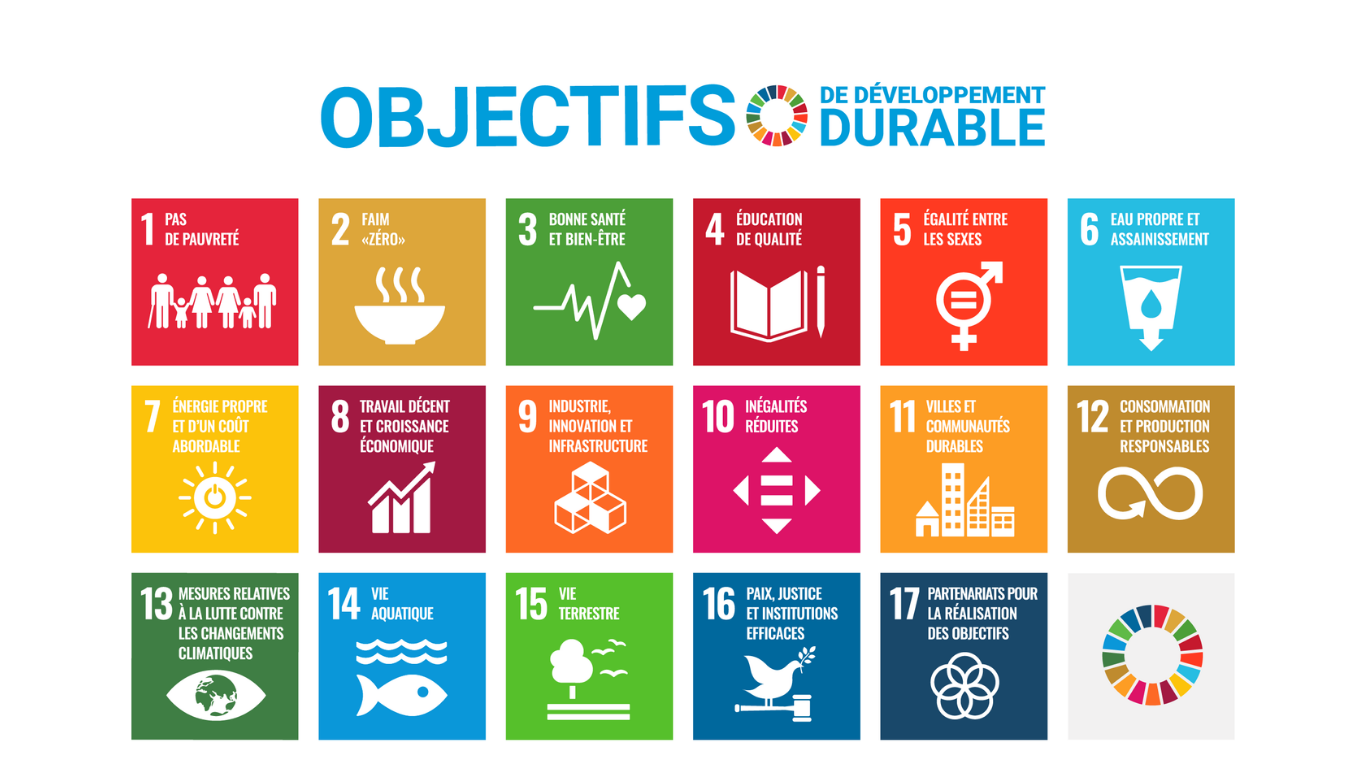
The Sustainable Development Goals (SDGs) are 17 goals aimed at transforming society. They provide a universal roadmap for people, the planet, peace, and prosperity.
In September 2015, 193 countries, including France, collectively committed to achieving the 17 SDGs by 2030 to build a more sustainable and inclusive world. We are all stakeholders in the SDGs, whether we are a local authority, an organization, or an individual citizen.
Four principles characterize the SDGs:
- The SDGs are universal: they apply to all countries, rich or poor, North or South, developed or developing. The SDGs recognize that global challenges like climate change and evolving development models require global solutions.
- The SDGs integrate all dimensions of sustainable development: economic growth, social progress, and environmental protection. For example, the SDGs tell us to produce enough food for everyone without destroying our soil or wasting water, or to grow our economy without increasing inequality.
- The SDGs commit to leaving no one behind: No goal should be considered achieved until it has been achieved for everyone, including the most vulnerable or marginalized.
- The SDGs rely on everyone's involvement: it is up to the United Nations and all partners and supporters to ensure that the SDGs and their inclusive message are accessible to all.
GRI stands for Global Reporting Initiative. It is an international organization that has developed one of the most widely used reporting frameworks in the world for publishing ESG information in a structured way (impacts, policies, actions, and indicators).
The "GRI Standards" are primarily used to:
• Define what to measure and what to explain regarding environmental, social, and governance topics;
• Standardize how information is presented so it is more comparable from one company to another;
• Produce reporting that is useful to stakeholders (clients, employees, partners, local communities, etc.), rather than just a communication exercise.
Key takeaway for SMEs/mid-caps : even if you don’t publish a full "GRI-compliant" report, this framework heavily influences many ESG questionnaires and expectations. It can also serve as a foundation for structuring your approach and selecting relevant indicators without starting from scratch.
SRI stands for Socially Responsible Investment. It is an investment approach that integrates ESG (Environmental, Social, and Governance) criteria alongside financial metrics to select companies or projects.
In practice, SRI aims to direct savings and funding toward players deemed more "responsible" (based on their practices, climate strategy, governance, social commitments, etc.). It can take several forms, for example:
• Selecting companies with the highest ESG ratings ("best-in-class" approach);
• Excluding certain sectors or practices (e.g., tobacco, weapons, coal, major controversies);
• Investing in a specific theme (e.g., energy transition, circular economy, inclusion).
Key takeaway for SMEs/mid-caps : even if you aren't a publicly traded company, SRI affects you indirectly. Banks, investors, and partners are increasingly using these ESG frameworks to assess risks and opportunities, which can influence your access to funding, information requests, or requirements in tender bids.
A-R-O stands for Avoid, Reduce, Offset. It is a framework primarily used in development, construction, or infrastructure projects to limit environmental impacts (particularly on biodiversity, soil, water, and natural habitats).
The principle is simple and follows this specific order:
1. Avoid: modify the project to eliminate the impact (this is the preferred option, as it is the only one that guarantees no degradation).
2. Reduce: when you cannot avoid everything, implement measures to decrease the scale, duration, or intensity of the impacts (during construction and/or operation).
3. Offset: as a last resort, compensate for residual impacts that remain despite avoidance and reduction efforts, through equivalent actions (restoration, creation, habitat improvement, etc.) according to the applicable framework.
Key takeaway : the A-R-O sequence follows a "most effective to least ideal" logic (avoid first, offset last). It frequently appears in files submitted for environmental assessment and certain authorization procedures.
SSE stands for Social and Solidarity Economy, which brings together organizations like cooperatives, foundations, mutuals, and non-profits, all driven by a commitment to solidarity and social impact.
Companies in the Social and Solidarity Economy reinvest their profits rather than prioritizing individual gain.
They are supported by a legal framework strengthened by Law No. 2014-856 of July 31, 2014, regarding the social and solidarity economy.
Key takeaway : SSE isn't a specific industry—you can find it in many fields. It’s a way of structuring a business, similar to CSR values but with specific rules for governance and profit distribution.

Your company's sustainable performance