Simply calculating your company's carbon footprint isn't always enough to boost your EcoVadis score. From methodology and scopes 1-2-3 to tools and BPI funding, here is the complete guide to turning your GHG assessment into a real scoring lever.


Conducting a corporate carbon footprint assessment isn't always enough to boost your EcoVadis score. From methodology, scopes 1-2-3, and tools to BPI funding: here is the complete guide to turning your GHG assessment into a powerful rating lever.
You’ve started your EcoVadis journey. Maybe you’ve even earned your first medal. Yet, year after year, the carbon criterion remains the sticking point—the one you answer halfway, using rough estimates gathered here and there.
This is a situation we see very often with French SMEs and mid-caps: the CSR process is well underway, but the corporate carbon footprint remains the missing link. It’s no coincidence that EcoVadis places such importance on it—greenhouse gas emissions have become one of the most closely watched indicators, both by the platform and by your clients and contractors.
Conducting a corporate carbon footprint assessment is no longer just a regulatory box to tick. It is one of the most direct levers for turning your CSR commitment into measurable results—for your rating, your tenders, and the trust you inspire in your stakeholders.
“Our goal is to ensure that CSR becomes a performance tool for your company.” — Nicolas Beslin, Altopi Partner
In this article, we review the method presented during our last webinar to help you succeed in your carbon footprint assessment and turn it into a real asset for your EcoVadis rating.
A carbon footprint is the evaluation, over a given period—usually a fiscal year—of the amount of greenhouse gases emitted by a company's activities. And we do mean "greenhouse gases" in the plural: the calculation takes into account all gases (methane, nitrous oxide, etc.), not just CO₂, even though it’s the one that gives the exercise its name through common usage.
This calculation is based on the various emission sources linked to the company's activity: sources of direct responsibility (fuel consumption, industrial processes) and all sources on which the activity depends indirectly—purchases of goods and services, transport, travel, waste management, etc. In total, a complete carbon footprint is broken down into nine major emission categories.
This is where many companies get lost, and it’s one of the questions that comes up most often in our webinars. There are actually four main frameworks:
Good news if you aren't subject to the 4-year regulatory requirement: nothing stops you from conducting a voluntary carbon footprint—and it is even recommended if you are targeting EcoVadis, which expects an annual measurement, not a triennial one.
Beyond regulatory requirements, five concrete issues are driving SMEs and mid-caps to take action today:
“The carbon footprint is a benchmark indicator and quite simple to request [in tenders].” — Clément, Altopi CSR Expert
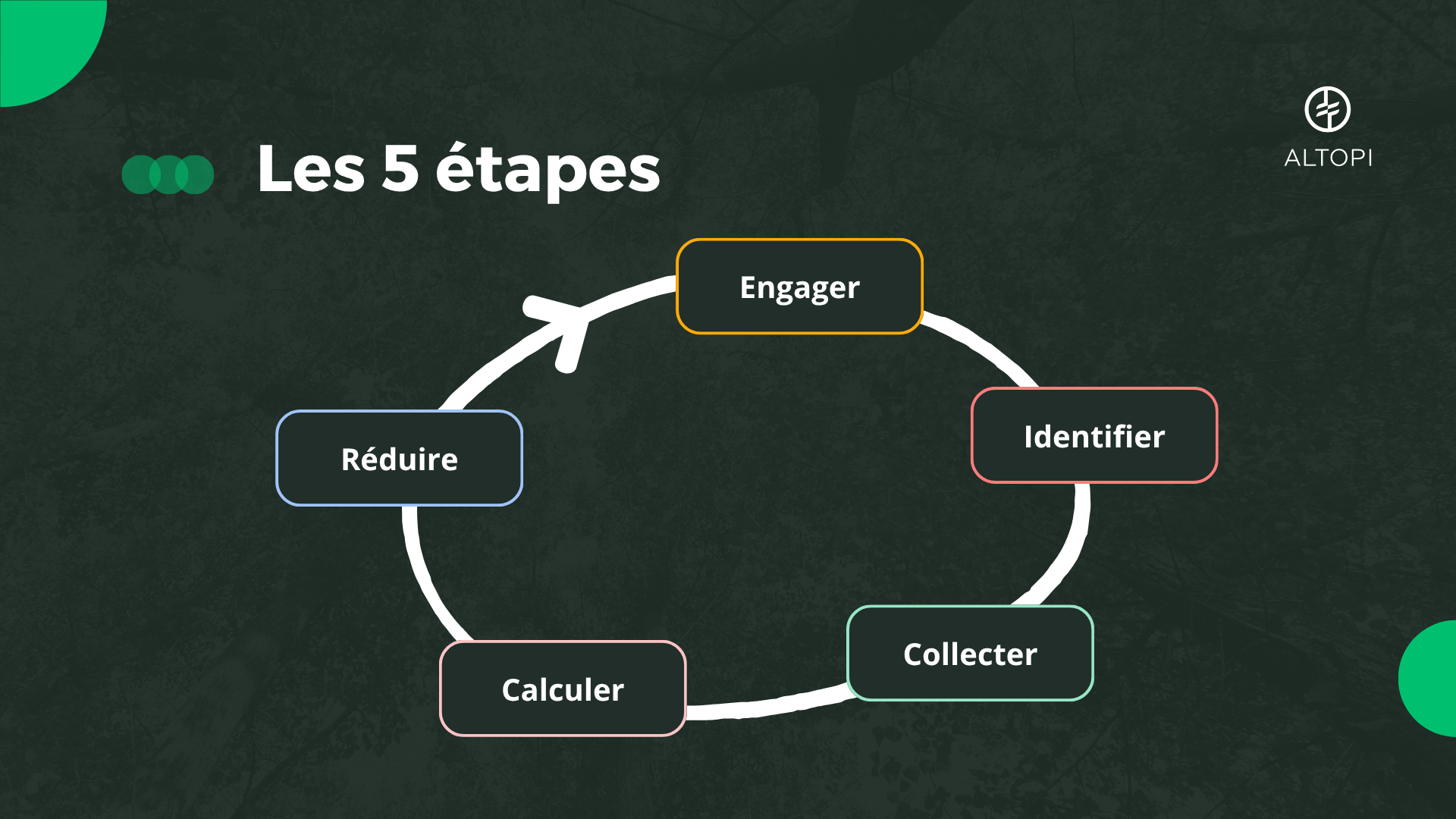
A successful carbon footprint assessment always follows the same five-step process.
Step 1 — Engage stakeholders. This is the most underestimated step. Without a clear kickoff involving management and regular communication on progress, the project will lose momentum due to a lack of time, purpose, or direction. Schedule regular check-ins (weekly or bi-weekly) and anticipate the workload for each contributor.
Step 2 — Define scope and identify data. Set your timeframe (fiscal year), your calculation scope (a single entity, an entire group, with or without subsidiaries), and then map out all the flows your business depends on.
This is where the famous scopes come in:
Step 3 — Collect data. This is the longest phase. Designate a lead for each data stream, set a clear deadline, and systematically verify unit consistency (a simple mix-up between kWh and MWh can skew an entire calculation).
Step 4 — Calculate. The principle is simple: multiply each collected activity data point by an emission factor to get a CO₂ equivalent. The difficulty isn't in the formula, but in the volume of data to process. One essential rule for accuracy: prioritize physical data (kilometers, kWh, kilos) over monetary data whenever possible. An "emission factor per euro spent" is much less reliable — the price of a train ticket can vary significantly for the same trip, while the distance traveled remains constant.
Step 5 — Reduce. The most important step: define a carbon trajectory (for example, aligning with the Paris Agreement goals), identify reduction levers for each category, estimate the impact of each action, and then prioritize and track their implementation over time.
To manage this process from start to finish, CSR consulting support or structured CSR management often makes the difference between a carbon footprint that stays in an Excel file and one that truly drives your strategy.
This is the link many companies don't leverage enough: a well-conducted carbon footprint directly feeds into several sections of your EcoVadis questionnaire.
Note, for the sake of precision: the carbon component does not directly impact your overall EcoVadis score out of 100. It feeds into a specific carbon assessment (rated as medium/high/etc.) associated with your profile, which is increasingly being checked directly by your clients and suppliers. In other words: even without a mechanical effect on your overall score, it is an element that is being scrutinized more and more in business relationships.
👉 To learn more about structuring your EcoVadis evidence, check out our EcoVadis Rating page — or, if your goal is to formalize your entire approach, our CSR Report solution.
A good carbon footprint calculation tool must check several boxes:
“Software won’t collect the information for you.” — Nicolas Beslin
This is the point we warn our clients about the most: beware of "one-click" carbon footprint promises. In the vast majority of cases, this means a calculation based exclusively on monetary data—fast, but fundamentally fragile and easily questioned by your stakeholders.
Software doesn't collect data for you, and while artificial intelligence can suggest potential carbon reduction paths, it is your deep knowledge of your business that will identify actions that are truly relevant—and, above all, truly achievable. This is why human support (kick-off meetings, regular data collection check-ins, data consistency verification) remains, in practice, what makes the difference between an actionable carbon footprint and just a number on a dashboard.
Need a CSR expert to frame your first initiative or validate a footprint already completed in-house? That is precisely where dedicated support makes all the difference.
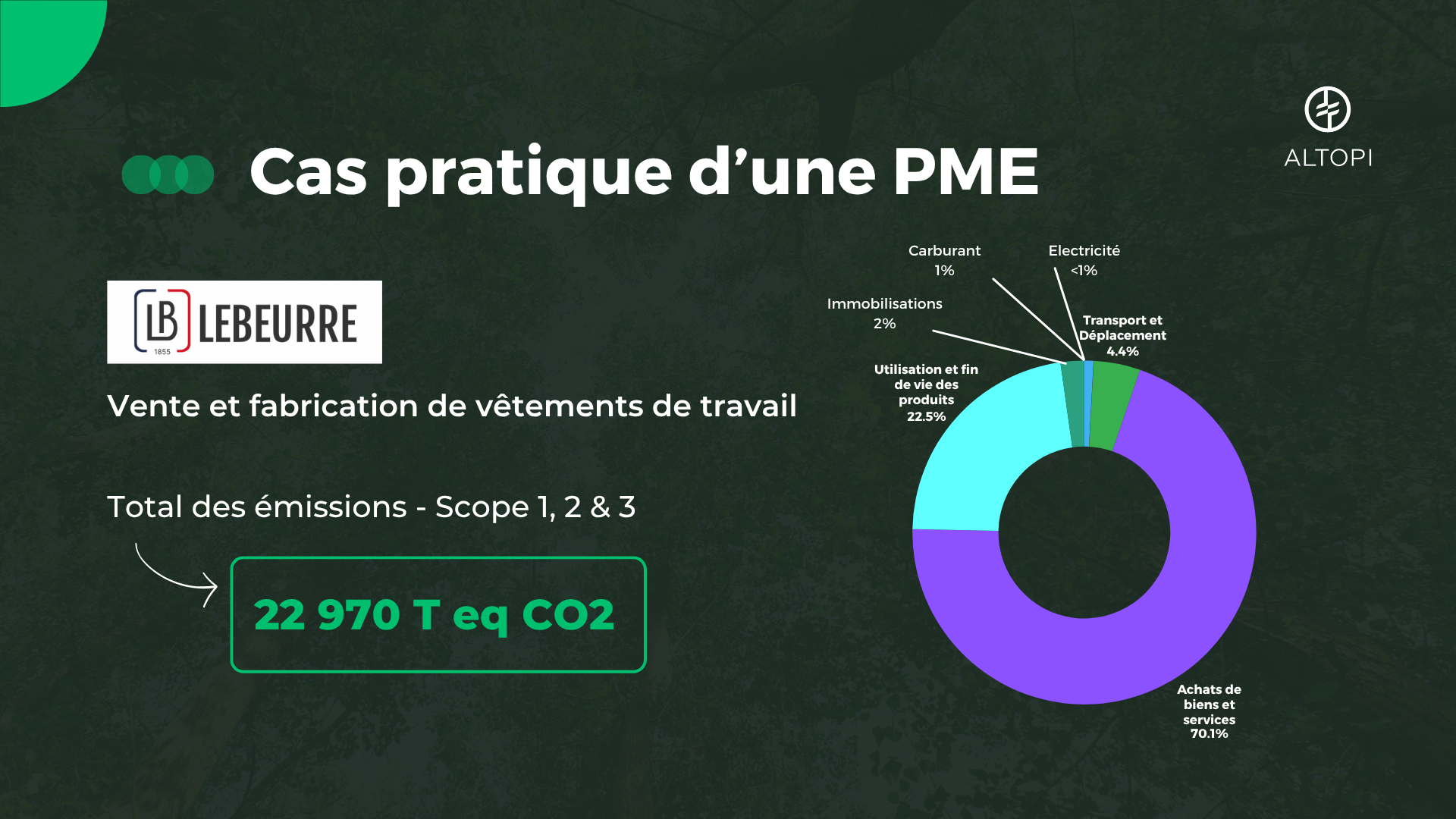
Let’s take the example of Lebeurre, a workwear manufacturer we assisted with their carbon footprint. The emissions profile of this company is quite representative of what we often see in the textile industry:
Based on this diagnosis, a concrete action plan was built with the client:
This is a good example of what a well-conducted carbon footprint systematically reveals: the most impactful areas are not always the ones you spontaneously think of (site energy, in this case, only represented a marginal share)—and it is precisely this precise diagnosis that allows you to prioritize the right actions rather than scattering your efforts.
Budgetary constraints are often the first objection SMEs have to their first carbon footprint. However, a program exists specifically for this: the Diag Décarbon'Action, supported by BPI.
This program is aimed at SMEs conducting their first carbon footprint, with coverage of up to €4,000. In practical terms, this funding helps cover:
This is a major government initiative to remove the financial barrier to decarbonization for SMEs and mid-sized companies. Altopi is a partner of this BPI-supported program and can assist you with both eligibility and the execution of the funded carbon footprint.
👉 Want to know if you are eligible for the Diag Décarbon'Action? Contact us for an initial chat.
What is an acceptable margin of error for a carbon footprint?
A carbon footprint always involves some uncertainty, depending on the nature of the data collected (physical vs. monetary, for example). There is no universal threshold: the goal is to document and gradually reduce this uncertainty from one year to the next, prioritizing the most reliable data for your highest-emission areas.
How often should you update your carbon footprint?
It depends on your goal. Regulatory GHG assessments require reporting every 4 years for companies that fall under the mandate. However, if you are aiming for EcoVadis, the platform values annual measurement tracked over three years—a more demanding pace, but one that builds a real trajectory over time rather than just a snapshot.
Should you include the entire product composition or just the main material?
Ideally, the entire composition should be included for a robust calculation, as each material has its own emission factor. In practice, you can prioritize the most significant materials by volume or impact, especially during your first assessment.
Does choosing recycled materials really impact GHG calculations?
Yes, absolutely. The emission factor for recycled polyester, for example, is significantly lower than for virgin polyester, since recycling requires less raw material to begin with.
Should we account for raw material shipping from the supplier or only from the factory?
The standard convention is to account for transport from the supplier to your site. Ideally, this data should be obtained directly from your supplier; if not, you can rely on generic data from reference databases (Base Empreinte, Ecoinvent, Agribalise, etc.).
How much does a carbon footprint cost for a company?
The price varies significantly based on company size, the complexity of its operations (especially Scope 3), and the level of support required. This is why the Diag Décarbon'Action (see chapter 8) is particularly useful for a first carbon footprint: it helps cover a significant portion of the cost.
A well-executed carbon footprint isn't just another burden for your EcoVadis process: it’s often the key to unlocking the most points, as it directly addresses your environmental policy, your measures, and your reporting.
Ready to calculate your carbon footprint and turn it into an EcoVadis asset? Contact Altopi for an initial chat—and let's check your eligibility for Diag Décarbon'Action funding (up to €4,000 covered by BPI).

Your company's sustainable performance