
Online event
Our CSR Webinars
×
Check out our webinars, replays, and upcoming sessions to start taking action on your CSR strategy.
Sign up for the next sessionCheck out our webinars, replays, and upcoming sessions to start taking action on your CSR strategy.
Sign up for the next sessionHow do you create a VSME report? Our 5-step method, illustrated by Altopi's full VSME module report, complete with key figures.


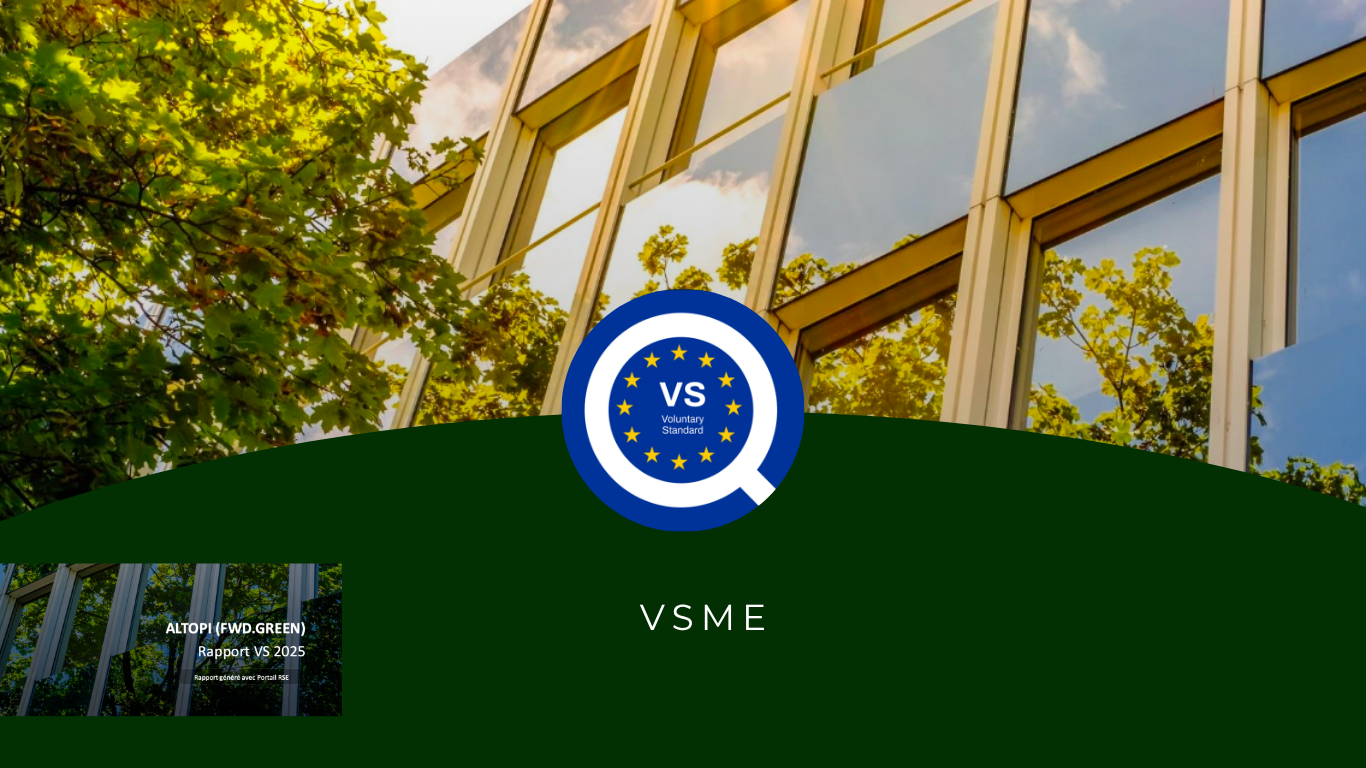
You hear about VSME everywhere, but what does a finished VSME report actually look like? We’ve completed our own, using the full module, and we’re publishing it. Here’s what’s inside, what we learned while building it, and the method for doing the same exercise in your own company.
We support nearly 500 SMEs and mid-sized companies in their CSR efforts. It’s hard to recommend a sustainability reporting exercise without having done it ourselves.
The regulatory context is also a factor. Since July 30, 2025, the European Commission has recommended (Recommendation (EU) 2025/1710) the use of VSME for companies not subject to the CSRD. With the Omnibus, published in the Official Journal of the European Union on February 26, 2026, the CSRD now focuses on companies with more than 1,000 employees. Furthermore, a company subject to the CSRD can no longer demand information from a partner with fewer than 1,000 employees that exceeds the VSME requirements. For an SME, this report is becoming the standard response to questionnaires from clients, banks, and contractors.
To understand the general framework, our article on the VSME standard details the modules and the differences compared to ESRS. Here, we’re getting practical.
The VSME (Voluntary Sustainability Reporting Standard for SMEs) is the voluntary sustainability reporting standard for SMEs, developed by EFRAG. It is divided into two modules:
We chose the full module. Our report is about forty pages long and was generated using the RSE Portal, the government's free public tool. It combines our HR data, energy consumption, and an estimate of our emissions, which is the basis of a carbon footprint. This is the type of deliverable we create for our clients as part of a CSR report.
For a consulting firm, the item that matters isn't heating, but what we buy. This explains our choices: refurbished IT equipment, second-hand furniture, and joining the Supplier Relations and Responsible Purchasing Charter in 2023.
In our report, several indicators are marked "not applicable": staff turnover for companies under 50 employees, the gender pay gap for companies under 150 employees, and gender parity in management for companies under 50 employees. This doesn't mean the report is empty. It means the standard is proportionate: check the thresholds before looking for data that isn't required of you.
Scopes 1 and 2 of our report fit on a single line. Scope 3 fills almost the entire page because you have to trace your purchases item by item. Plan to spend most of your time on this, and start with your supplier list.
We don't have data on our water usage yet, and our waste is limited to household waste. The report states this as is. The VSME doesn't expect perfection; it expects transparency and a trajectory. Our gaps today are our roadmap for next year.
While filling out the section on practices and policies, we saw in black and white that our policies weren't public yet, and that our responsible purchasing policy for the value chain was still "in development." Simply publishing this report already corrects the first point.
The VSME doesn't replace the CSRD or an EcoVadis assessment, but it feeds into them:
Do you have less time than data? That is exactly what we do for our clients: an assessment, a carbon footprint, and then a report ready to send to your principals.
Is the VSME report mandatory? No. It is voluntary. It is the client, the financier, or the principal who will ask you for it, and the CSRD does not require anything from you as long as you remain below the thresholds.
What is the difference between a VSME report and a CSR report? The VSME report follows a standardized European structure (B1 to B11 and C1 to C9), which makes it comparable and faster to produce. A CSR report is more flexible, more narrative, and can use the VSME for its figures.
Can you do your VSME report with the CSR Portal? Yes, that is what we did. The tool is free and guides the entry process. The support is mainly used to collect the right data, calculate emissions, and make the result actionable.
Should you choose the basic module or the full module? The basic module is sufficient for most client requests. The full module provides strategy, targets, and climate risks: useful if you want to manage your approach or respond to demanding tenders.
What should you do with "not applicable" indicators? You leave them as they are. The standard is proportionate to the size of the company, and an indicator that is below the threshold is not a shortcoming.
Do you want to complete your VSME report without spending weeks on it? We help you choose the right module, collect your data, and produce a report that your clients can use.
Book a 30-minute VSME diagnostic: contact us!