What is a Carbon Footprint? How is it calculated? You'll find all the answers to your questions in this article!



The Carbon Footprint is a diagnostic tool created by ADEME. It allows you to account for your company's greenhouse gas emissions.
It provides a snapshot by calculating the company's direct and indirect greenhouse gas emissions. Knowing the source of your carbon emissions makes it easier to develop an action plan to reduce them.
The Carbon Footprint calculation takes into account emissions from 6 gases:
- carbon dioxide or CO2
- hydrofluorocarbons
- methane
- perfluorocarbons
- nitrous oxide
- sulfur hexafluoride
All gases are converted into carbon equivalents, and the final carbon footprint result is expressed in tonnes of CO2 equivalent.
The carbon footprint calculation method involves considering the entire life cycle of the products and services offered. The Carbon Footprint is also based on the following emission categories:
- The energy required for the manufacturing and use of a product or service.
- Inputs, which represent the quantities purchased
- Freight: the movement of goods
- Travel by people
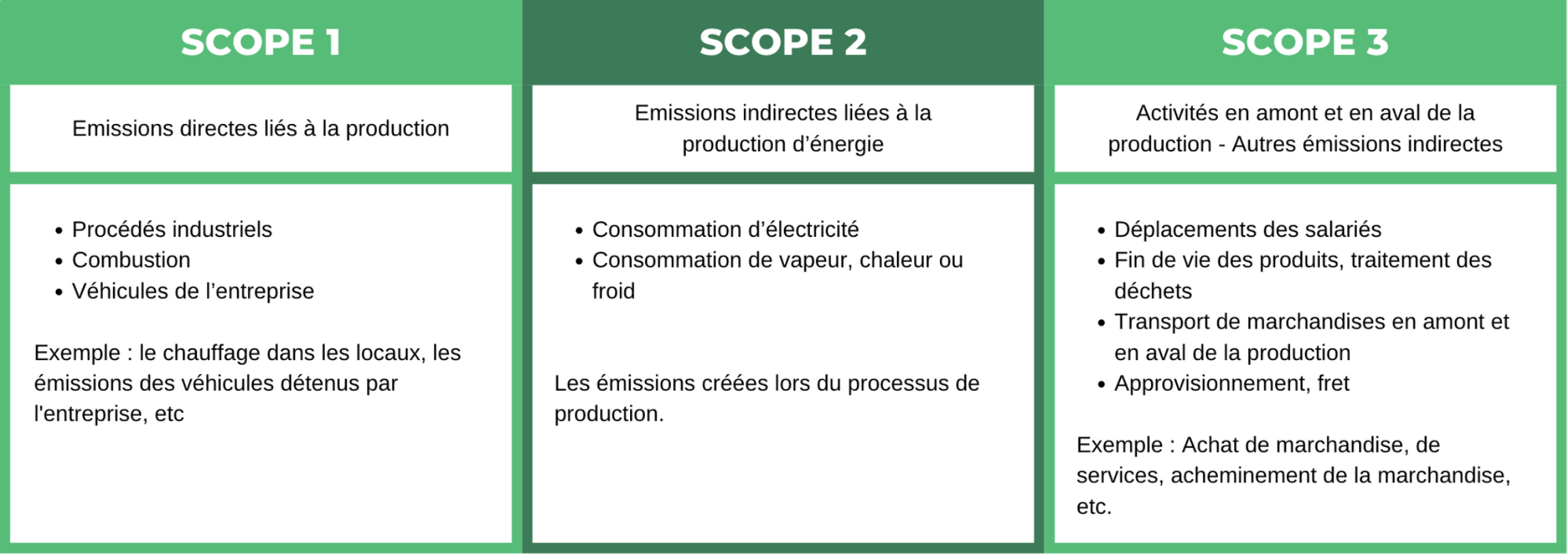
These emission categories are organized into scopes 1, 2, and 3.
The purpose of the scopes is to identify greenhouse gas emission sources by category or type of activity within an organization.
- Scope 1 covers direct emissions (e.g., heating in your offices, emissions from company-owned vehicles, etc.)
- Scope 2 refers to indirect energy-related emissions generated during the production process (e.g., electricity consumption).
- Scope 3 accounts for other indirect emissions (e.g., purchasing goods, services, etc.)
Appoint an internal lead. Define the reference year for the carbon footprint. Define your operational and organizational scope. Choose the method you will use to conduct the carbon footprint. Raise awareness among employees who will be involved in data collection and, later, in the actions implemented from the study.
Collect primary data already available within your organization. Depending on the chosen operational scope, you will also need to gather data from your suppliers, clients, users, etc., or use statistical data (generic or secondary data).
Match each piece of collected data with its equivalent in GHG emissions.
Publish a comprehensive Carbon Footprint report.
Altopi can help you get it done. With our online Carbon Footprint calculation tool, we make it easy to accurately assess your company's greenhouse gas emissions. Discover the solution
Check out our article to learn more about what a carbon footprint is, how it's calculated, and what Scopes 1, 2, and 3 mean.
Check out our article to learn more about the Carbon Footprint, how long it remains valid, why your company should implement one, and how much it might cost.

Your company's sustainable performance