Measure your products' carbon footprint to meet client expectations, stay ahead of regulations, and boost your competitiveness. From methodology and LCAs to best practices, discover how to tangibly reduce your environmental impact.



Reducing environmental impact has become a key competitive advantage. Discover why measuring your product's carbon footprint is a strategic priority for your business, how product life cycle analysis works, the best calculation methods to use, and how to effectively lower your carbon impact.
Calculating a product or service's carbon score—measuring the total CO2 and other greenhouse gases emitted throughout its life cycle—has become a vital indicator for understanding and mitigating climate change impact.
Consumers, investors, and regulators are increasingly demanding precise data on environmental impact. Factoring in a product's carbon footprint is now a critical benchmark for competitiveness.
Furthermore, regulations are tightening, particularly in Europe with the Corporate Sustainability Reporting Directive (CSRD), which requires large companies to report on their ecological footprint and the actions taken to reduce it.
Tenders now frequently include CSR criteria, making a product's carbon score an essential factor in winning new business.
Consumers are paying closer attention to the origin and environmental impact of the products they buy. By measuring and reducing their carbon footprint, companies meet this growing demand by offering responsible, low-impact products, which can significantly boost their appeal.
Transparency regarding sustainability is becoming a major marketing asset. A product with a lower carbon score offers unique, added value. This allows a company to position itself as a leader in the ecological transition and capture consumer interest.
Product Life Cycle Assessment (LCA) helps identify which stages of manufacturing or distribution generate the most greenhouse gas emissions. This not only helps reduce a product's carbon footprint and implement a low-carbon strategy, but also optimizes costs by improving efficiency. For example, by optimizing transport or choosing raw materials with a lower climate impact, companies can improve both their environmental and economic performance.
Evaluating a product's carbon score is primarily based on Life Cycle Assessment (LCA).
This method involves assessing a product's environmental impact throughout its entire life cycle, from raw material extraction to end-of-life (recycling, disposal, etc.).
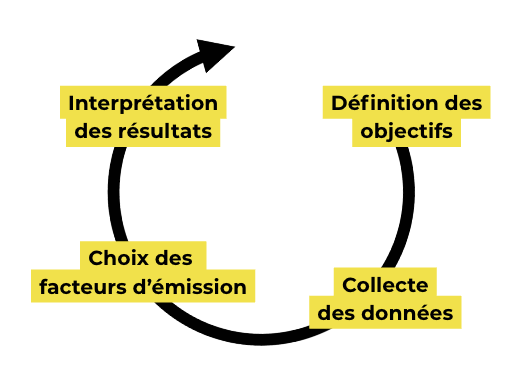
The first step in measuring a product's carbon score is to determine the scope. Two approaches are commonly used:

The scope also varies depending on the industry (textiles, food processing, furniture, etc.).
For example, in the food industry, it is essential to include the impact of agricultural stages in your measurement, particularly the use of inputs and irrigation, as well as processing, including cooking and refrigeration. Transport to the customer also plays a key role. Special attention must be paid to food waste and packaging, which have a significant impact.
A comprehensive LCA must both comply with various regulations such as the ISO 14040/14044 standard and rigorously document the methodological choices made.

To obtain accurate results, it is essential to collect reliable data. There are many sources of greenhouse gas emissions, including:
It is essential to collect quality data for each stage of the life cycle in order to obtain an accurate and actionable carbon score.

Once the data has been collected, it is translated into environmental indicators.
Greenhouse gas emissions are converted into tonnes of CO2 equivalent (CO2e). These results provide a carbon score and help determine where efforts can be made to reduce impact.
The analysis can also include parameters such as global warming, depletion of natural resources, and other environmental criteria.
To ensure a reliable and useful calculation, here are some best practices to follow:
A well-calculated product carbon score becomes much more than just an environmental indicator. It is a strategic tool for companies looking to embrace sustainable development, meet consumer expectations, and win tenders. By mastering this method, companies can reduce their footprint and strengthen their market position.
Do you need to respond to a tender requiring carbon data? Altopi supports you from A to Z in creating your Product/Service Carbon Score, a strategic lever for gaining competitiveness and transparency.
Our support includes:
Upcoming tender? Specific client request? Let’s talk about it now to build your carbon strategy together!

Your company's sustainable performance