Need to conduct an LCA? Discover a simple 4-step method (scoping, LCI, calculation, communication) and how Altopi supports you throughout the process.


Need to conduct a Life Cycle Assessment (LCA) because a client, a tender, or your management is asking for one... but you don't know where to start?
Good news: there is a simple method to structure your approach, collect the right data, and get reliable results without getting lost in the technical details.
In this article, we explain the basics of LCA and the 4 steps to launch it effectively.
A Life Cycle Assessment (LCA) is used to measure the environmental impact of a product or service. It looks at the entire journey: raw materials, manufacturing, transport, use, and end-of-life. The goal is simple: avoid focusing on the wrong priorities and prevent shifting impacts elsewhere.
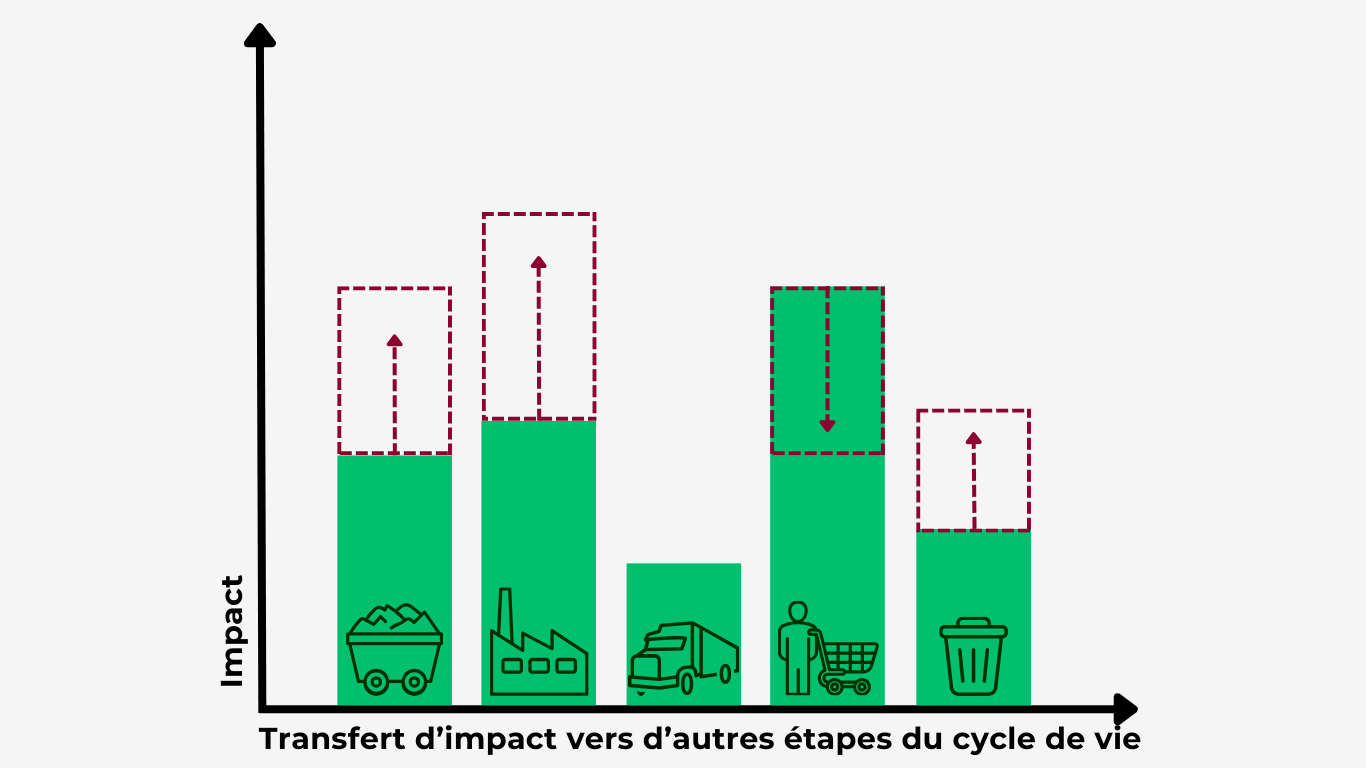
An LCA measures environmental impacts, such as those on the climate (CO₂), water, resources, or pollution, depending on the indicators you choose. It does this within a pre-defined scope: either the entire life cycle of the product or service, or just a specific part of it.
We conduct an LCA to make fact-based decisions. It helps identify what really drives the impact of a product or service, allowing you to take action where it actually matters.
In practice, an LCA meets several very concrete needs:
• Taking climate action : by reducing the environmental impacts of your products and services, you contribute to the collective effort to lower emissions.
• Responding to clients and tenders : more and more companies are required to justify and reduce their emissions, and they expect reliable data from their suppliers.
• Launching an eco-design initiative : an LCA helps compare options (materials, packaging, transport, lifespan) and avoid "false solutions."
• Structuring the company and mobilizing teams internally : it is a clear tool for getting teams on board with a concrete, measurable project.
• Anticipating regulations : eco-design requirements are tightening, particularly at the European level, and an LCA helps you prepare for them.
• Reducing costs : eco-design often leads to using fewer materials, less energy, and less waste... which means cost savings.
In short, an LCA is used to guide, improve, and justify: it is simultaneously a technical tool, a communication asset, and a lever for transformation.
Life Cycle Assessment is based on an internationally recognized methodological framework. The ISO 14040 and ISO 14044 standards define the principles and requirements for measuring the environmental impacts of a product or service throughout its entire life cycle.
These standards set the rules for conducting a reliable LCA: clearly defining the study's objective, choosing a consistent scope, using relevant data, and documenting assumptions. They also emphasize several key requirements: the relevance of results, data completeness, calculation accuracy, transparency of methodological choices, and overall consistency.
This framework ensures results are comparable, credible, and actionable, whether you're guiding internal decisions, responding to client requests, or communicating responsibly.
The scoping phase is crucial: it saves a lot of back-and-forth later on. Before collecting data, clarify why you are conducting this LCA: to answer a client, respond to a tender, settle an internal debate, or prepare a communication campaign. Then, define what you expect from the results: a specific figure, a comparison between two options, or an action plan.
Example objective: "Compare two types of packaging to choose the one with the lowest impact for the same usage."
Once the objective is set, establish the scope, which acts as the "ground rules" for your LCA:
- Which product or service is being studied (which version)
- What is the functional unit (e.g., 1,000 uses, 1 year, 1 km)
- What are the boundaries (the entire life cycle or just a part)
- What is the geographic area (France/EU/Global)
- And which scenarios (actual usage, lifespan, recycling, etc.)
The LCI (Life Cycle Inventory) is the stage where you map out everything that happens throughout a product's life cycle. You look at each stage — raw materials, manufacturing, transport, distribution, use, end-of-life, and recovery — and for each one, you list all inputs and outputs. The goal is simple: start with concrete facts (data) so you can reliably measure environmental impact.
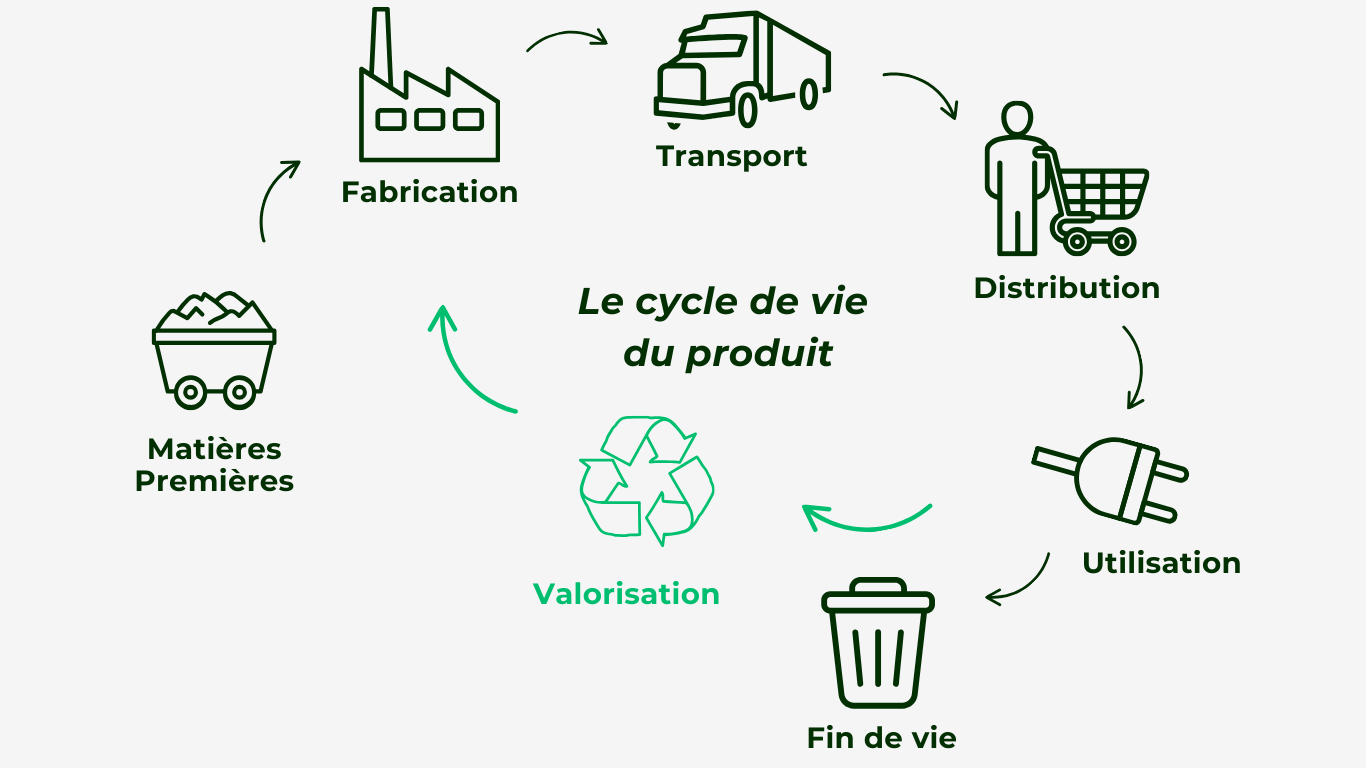
In practical terms, you list all input flows, such as materials, energy, or resources consumed, and all output flows, such as emissions, discharges, or waste generated. This step-by-step inventory work is what allows you to perform accurate calculations and avoid guesswork.
Here, you turn your data into a model to calculate impacts, using a simple logic: Impact = data × impact factor
Each piece of data is linked to the functional unit and then converted using factors from environmental databases.
There are several ways to perform this calculation:
A spreadsheet is a flexible and low-cost solution. It allows you to structure flows and test different scenarios. However, it doesn't include an automated methodological framework, databases must be imported manually, and real expertise is required to avoid errors.
Specialized LCA software offers a more robust framework. They include comprehensive databases, methods that comply with standards, and make modeling easier. Some of the most widely used tools include Orki, SimaPro, or OpenLCA. These solutions provide more exhaustive and comparable results, but they do require a budget and some technical training.
Finally, you can always work with a specialized firm. This option helps secure your methodology, saves time, and reduces the internal workload.
Regardless of the tool you choose, always document your assumptions in black and white (energy mix, distances, scrap rates, end-of-life, etc.). You need to be able to easily explain where your figures come from.
When interpreting results, get straight to the point: identify the most significant stages, pinpoint the levers that actually reduce impact, then check for robustness (if a key assumption changes, does the conclusion still hold?). This is important because an LCA doesn't have a single "truth": results vary depending on the scope, method, and database used, so be careful with comparisons.
To communicate effectively, the calculation must always be presented with key information: functional unit, system boundaries, stages included, exclusions, proxies, emission factors, and uncertainty.
An LCA is a powerful tool, but its results depend heavily on the choices made at the start. Certain mistakes are common when getting started and can skew the analysis or make the findings difficult to use. Knowing them will save you time and prevent you from having to start over.
The functional unit is the foundation of any LCA. It defines what you are actually comparing: a product, a use case, or a lifespan.
A common mistake is comparing products based on weight or unit count without considering actual usage. For example, comparing two types of packaging without accounting for their capacity or duration of use can lead to misleading conclusions.
A good functional unit should always reflect the service provided (e.g., "packaging 1,000 products," "traveling 1 km," or "using a product for 1 year").
When primary data is hard to come by, we often use generic data from databases. This is normal, especially at the beginning.
The problem arises when this data is too far from reality: different production countries, non-representative technology, or overly rough assumptions. This can reduce the reliability of your results.
The goal isn't to have perfect data for everything, but to prioritize the most important data: main materials, energy, transport, and end-of-life.
Comparing two products only makes sense if the ground rules are identical: same functional unit, same scope, and same usage and end-of-life assumptions.
Non-equivalent comparison is one of the most frequent errors. For example, comparing a reusable product to a disposable one without accounting for the number of uses can lead to an erroneous conclusion.
Before comparing, always verify that the scenarios are consistent.
End-of-life is often overlooked due to a lack of data or time. Yet, it can significantly affect results, whether through recycling, reuse, incineration, or landfilling.
Ignoring this stage can lead to underestimating or overestimating certain impacts. Even with rough data, it is better to include a realistic scenario than to ignore it entirely.
To understand how an LCA works, let’s look at a simple example: a life cycle assessment of a t-shirt.
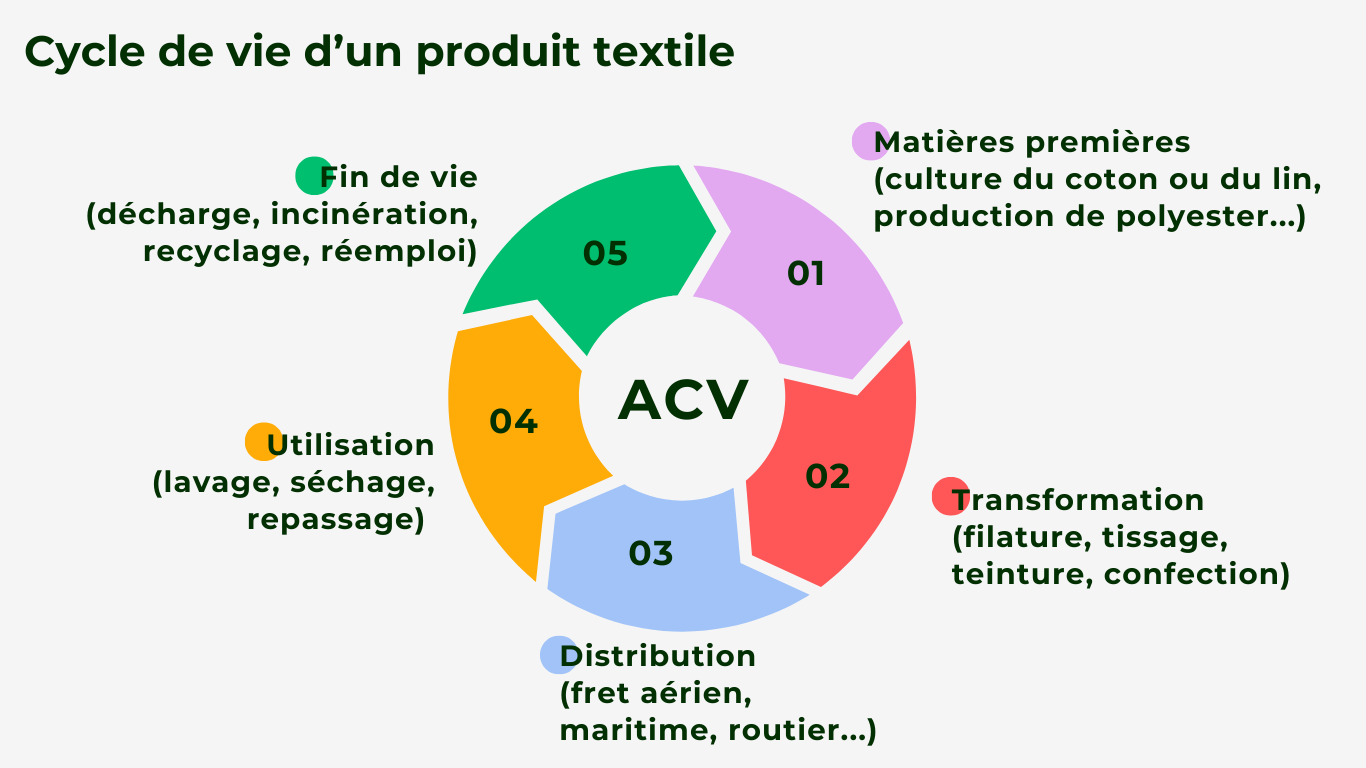
The goal is to identify the stages with the greatest environmental impact to guide eco-design choices and enable transparent communication. Here, we examine an adult t-shirt over its entire life cycle, "from cradle to grave": raw materials, manufacturing, transport, use, and end-of-life.
The functional unit could be, for example: 1 t-shirt worn 50 times.
The first stage involves fiber production (cotton, polyester, linen, etc.).
This phase can have a significant impact:
• Water and land use for natural fibers
• Fertilizers and pesticides for certain crops
• Chemical processes and energy for synthetic fibers
The weight and origin of the materials therefore play a key role in the overall impact.
The t-shirt is then manufactured: spinning, weaving, dyeing, and assembly.
These steps consume energy, water, and sometimes chemicals.
The country of manufacture, the processes used, and material waste strongly influence the results.
The transport between the various stages (factories, warehouses, stores) generates emissions.
This phase is often less impactful than production, but it depends on the mode of transport, distances traveled, and the weight of the product. Packaging is also taken into account.
How you use a t-shirt also has an impact: washing, drying, and ironing all consume energy and water. The number of washes and the garment's lifespan significantly influence the results. The longer a product is used, the more its impact is "offset."
Finally, we look at what happens to the t-shirt: recycling, reuse, incineration, or landfill.
The actual percentage recycled and the end-of-life scenarios change the total impact.
This simplified LCA shows that a product's impact doesn't depend on just one stage.
It helps identify the main levers:
• Choosing the right materials
• Optimizing manufacturing
• Reducing transport
• Extending product life
• Improving end-of-life
That is exactly what an LCA allows you to do: see the entire life cycle to take action where it matters most.
An LCA should be updated whenever a key element changes: product modifications, changes in suppliers or production sites, new transport distances, shifts in the energy mix, or new regulatory requirements. These changes can have a direct impact on the results and the decisions based on them.
Even without major changes, it is recommended to review your LCA regularly to ensure that the data and assumptions remain valid. This keeps your results reliable, comparable over time, and ready to use for customers or in your communications.
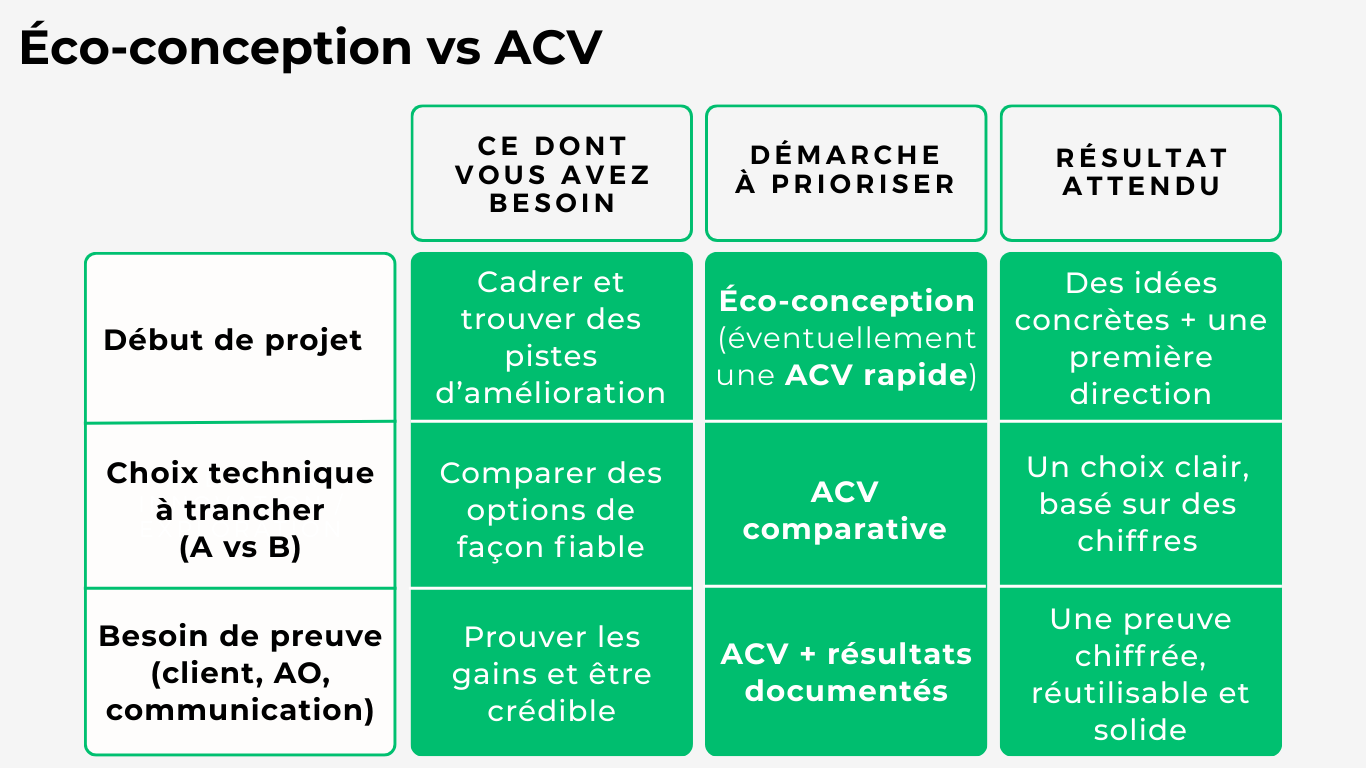
LCA and eco-design are often mentioned together, but they serve different needs at different times. Eco-design is a process (how to design better, from the start). LCA, as we just saw, is a measurement tool (how to objectify, compare, and prove).
In practice, you might use one, the other, or both depending on the project's maturity and the level of decision-making required. How do you choose based on your level of maturity?
LCA, Carbon Footprint, and Product Carbon Footprint are three complementary methods for measuring environmental impact, but they serve different purposes.
LCA is the most comprehensive approach: it evaluates multiple environmental impacts (climate, water, resources, pollution, etc.) across the entire life cycle of a product or service, in accordance with ISO 14040 and 14044 standards.
A Carbon Footprint, on the other hand, focuses solely on greenhouse gas emissions for an entire organization (company, site, activity), typically following the GHG Protocol or ADEME methodology.
Finally, a Product Carbon Footprint also measures only CO₂ emissions, but at the level of a specific product or service, in accordance with ISO 14067.
In short: LCA is used to compare and eco-design products with a multi-criteria view, Carbon Footprint manages an organization's overall carbon footprint, and Product Carbon Footprint provides a single carbon indicator for a specific product.
To learn more, check out our dedicated article: What is the difference between LCA and Carbon Footprint?
LCA is now a core tool for CSR initiatives. Companies are increasingly required to justify their choices—regarding materials, suppliers, transport, and product lifespan—and both customers and regulators expect reliable data.
In practice, LCA helps guide eco-design, respond to tenders, build credible environmental communication, and avoid counterproductive decisions that shift impacts rather than reducing them.
For SMEs and mid-caps, it has become a true management tool, useful for making decisions and prioritizing actions.
At Altopi, we offer end-to-end LCA support for SMEs and mid-caps : scoping, data collection, calculation, and action planning. Our experts apply a methodology that complies with standards, with minimal workload for your teams (using templates, managing follow-ups, and limiting requests). The result: a reliable LCA and a clear, professional report ready to be used internally, with your clients, or for tenders.
It depends on the scope (screening vs. full assessment), the number of suppliers, and data availability. In practice, the timeline is mostly determined by data collection and the validation of assumptions.
LCA is the calculation method used to evaluate the environmental impacts of a product throughout its entire life cycle.
The FDES (Environmental and Health Declaration Sheet) is a standardized document used in the construction sector. It presents the results of an LCA in a specific format to allow for comparisons between construction products.
The PEP ecopassport is an environmental declaration for electrical, electronic, and HVAC equipment. Like the FDES, it is based on an LCA conducted according to sector-specific rules.
Yes, but only if the ground rules are the same. To compare two products, you need an identical functional unit, consistent system boundaries, comparable assumptions (usage, lifespan, end-of-life, etc.), and ideally the same method and database. Otherwise, you’re comparing results that don’t tell the same story.
In short, a successful LCA relies on clear scoping, well-collected data, documented assumptions, and understandable reporting. With an efficient method and a well-structured deliverable, you save time… and avoid pushback.

Your company's sustainable performance